Choosing the right enclosure material plays a major role in durability, corrosion resistance, and long-term performance. This guide compares 5052 aluminum, 304 stainless steel, and 316 stainless steel to help determine which material best suits your application.
When ordering a custom electrical enclosure, it is essential to select the right material to ensure durability and functionality. Cost-effectiveness is another key factor to consider. Contact Foxfab sales for assistance in selecting the best material for your needs. Below are key considerations and comparisons for 5052 aluminum, 304 stainless steel, and 316 stainless steel:
5052 Aluminum
Corrosion resistance—Aluminum is an excellent option for environments with moderate exposure to moisture or other chemicals, but it is not necessarily suited for heavy industrial or marine settings.
Weight - It is a lightweight material, making transporting and handling easier during shipping. This also applies to installation, where a lightweight enclosure is easier to handle during installation.
Cost - Regarding cost, aluminum is the more budget-friendly option while maintaining a high-quality and functional build.
Workability—Aluminum is preferred because of its high malleability, which allows it to be more easily worked into different shapes and parts. It is excellent for custom cabinet designs.
304 Stainless Steel
Corrosion resistance - 304 Stainless Steel demonstrates strong resistance to rust and corrosion in typical environments and is suitable for indoor and outdoor applications with mild to moderate exposure to the elements.
Durability—Stainless steel provides high tensile strength, which in turn ensures better long-term performance, such as enhanced structural integrity and resistance to wear. This increased durability also allows the enclosure to withstand impacts and vibrations better.
Cost—The cost exceeds 5052 Aluminum but is less than 316 stainless steel. It provides a balance between price and performance.
Appearance—This material provides a polished and professional appearance. It is ideal for locations visible to the public or for aesthetic-sensitive applications.
316 Stainless Steel
Corrosion Resistance—316 stainless steel's corrosion resistance is superior to that of 304 StainlessSteel and 5052 Aluminum. 316 Stainless steel is the best option for chemical, marine, and harsh industrial environments.
Longevity—it can offer an extended service life, even in harsh conditions. Required maintenance can also be reduced, lowering long-term costs.
Cost—316 stainless steel is the most expensive, but it offers all the advantages of 316 stainless steel. However, it delivers unmatched performance, making it ideal for critical applications. It is best used in harsh conditions or critical situations.
Special Features—this is an ideal option for coastal installations because it is resistant to chlorides and saltwater. It also maintains a high tolerance for high temperatures and pressures.
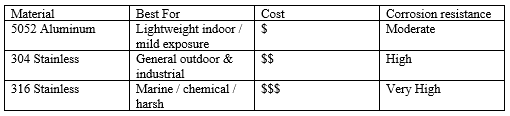
Quick Material Comparison
The table below summarizes key differences to help guide material selection.
Key Differences Between 5052, 304, and 316
Additional Protection: Standard Powder-Coated Finish
All Foxfab enclosures are supplied with a durable powder-coated finish as standard, providing added protection against corrosion, abrasion, and environmental exposure. This coating forms an additional protective barrier that helps extend service life in outdoor and industrial environments while maintaining a clean, professional appearance.
Combined with material selection, powder coating enhances long-term performance and reliability across Foxfab products, particularly in demanding installations.
Determining the right material for the job may not be easy. It involves balancing performance, cost, and environmental conditions.
5052 Aluminum is an excellent option for something lightweight and cost-effective with good protection in areas with moderate exposure.
304 Stainless steel is good when you want a balance between affordability, appearance, and durability.
316 Stainless steel is the best option when high corrosion resistance is required, especially in harsher environments.
Understanding your needs and the materials' strengths and limitations will help you decide on the enclosure that best suits your project's needs.
📩 Contact Quotes@foxfab.com or visit www.foxfab.com to explore the right generator connection solution for your facility.


.png)